MILESTONE < STANDARDISATION
In a competitive business environment, standardisation of processes and parts plays a critical role as the engine that drives best performance. Just as a team of expert mechanics in a Formula 1 race tweaks every detail to achieve maximum efficiency, our methodology recognises that the key to success lies in optimising every step, eliminating waste and ensuring consistency in every aspect of our operations.
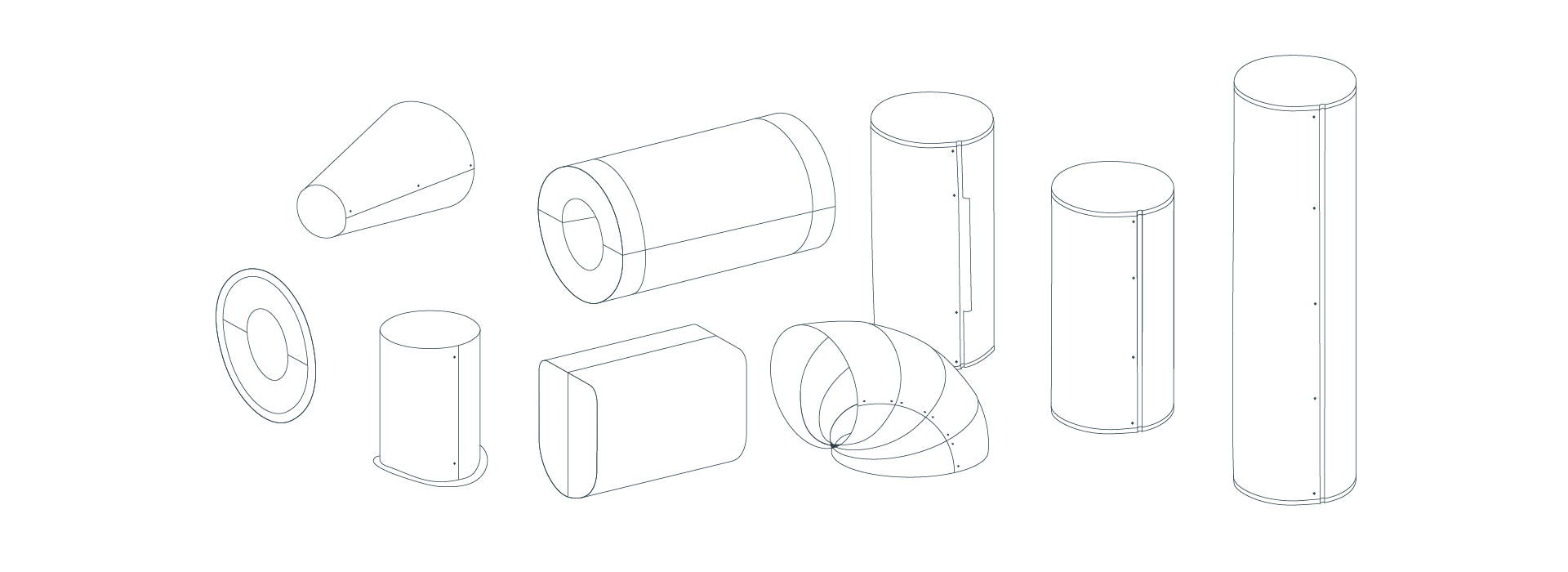
Think of our process standardisation as the meticulous tuning of a Formula 1 car, where each process becomes a vital part of our business machine. Standardising parts in this context is like creating a precise catalogue where each part fits perfectly, ensuring simplified management and easier installation.
This standardisation ensures consistency and reduces variability, allowing us to achieve optimum performance in every area. Join us on this journey, where efficiency and continuous innovation are our formula for business growth.

Standardisation
=
same process of …
MEASURING

ORDERING
PREFABRICATION
INSTALLATION
Standardisation
=
catalogue
WORKING WITH STANDARD PARTS OPTIMISES RESOURCES
The implementation of a standard parts catalogue not only leads to increased operational efficiency, but also streamlines the management of the various stages of the process, from request and manufacturing to logistics and overall project management.
In this catalogue, each part is defined according to the most advantageous criteria defined by the business unit, taking into account parameters such as diameter, length or material, in order to obtain a consistent “product”.
Benefits highlighted include:
MEASURING
> Eliminates the need to measure each part. Just measure the support and count the number of units.
ORDERING
> Streamlines the ordering process. The Bill of Materials (BOM) provides a breakdown of the parts required, eliminating the need to order each part separately.
PREFABRICATION
> Simplifies production with a standardised set of parts.
> Efficient creation of work batches.
> Ensures the quality of the parts.
> Optimises machine utilisation through part uniformity.
LOGISTICS
> Improves logistics management by simplifying processes.
> Implementation of a tracking system for each part.
MANAGEMENT
> Advanced knowledge of the price of each part before placing an order.
> More effective work planning and materials management.
> Significant reduction in process variation through uniformity and standardisation.